
 |
|
This article from the Indian Express serves as a key resource for individuals preparing for the Union Public Service Commission (UPSC) Civil Services Examination (CSE), specifically targeting the May 27, 2025 exam. It covers a range of important topics relevant to the UPSC syllabus, including national and international current events, Indian polity and governance, economic and social development, and geography. The article highlights several key areas for potential exam questions, delving into the intricacies of 'red teaming' in military operations, the Madden-Julian Oscillation's impact on monsoon patterns, advancements in railway connectivity in the North-East, the upcoming Rajya Sabha elections, tribal concerns regarding the Great Nicobar project, NITI Aayog's proposals for medium-sized enterprises, the definition and implications of monsoon onset, advancements in gene-editing technology, and China's mission to sample a near-Earth asteroid. The comprehensive coverage ensures that aspirants are well-informed on diverse topics crucial for the exam.
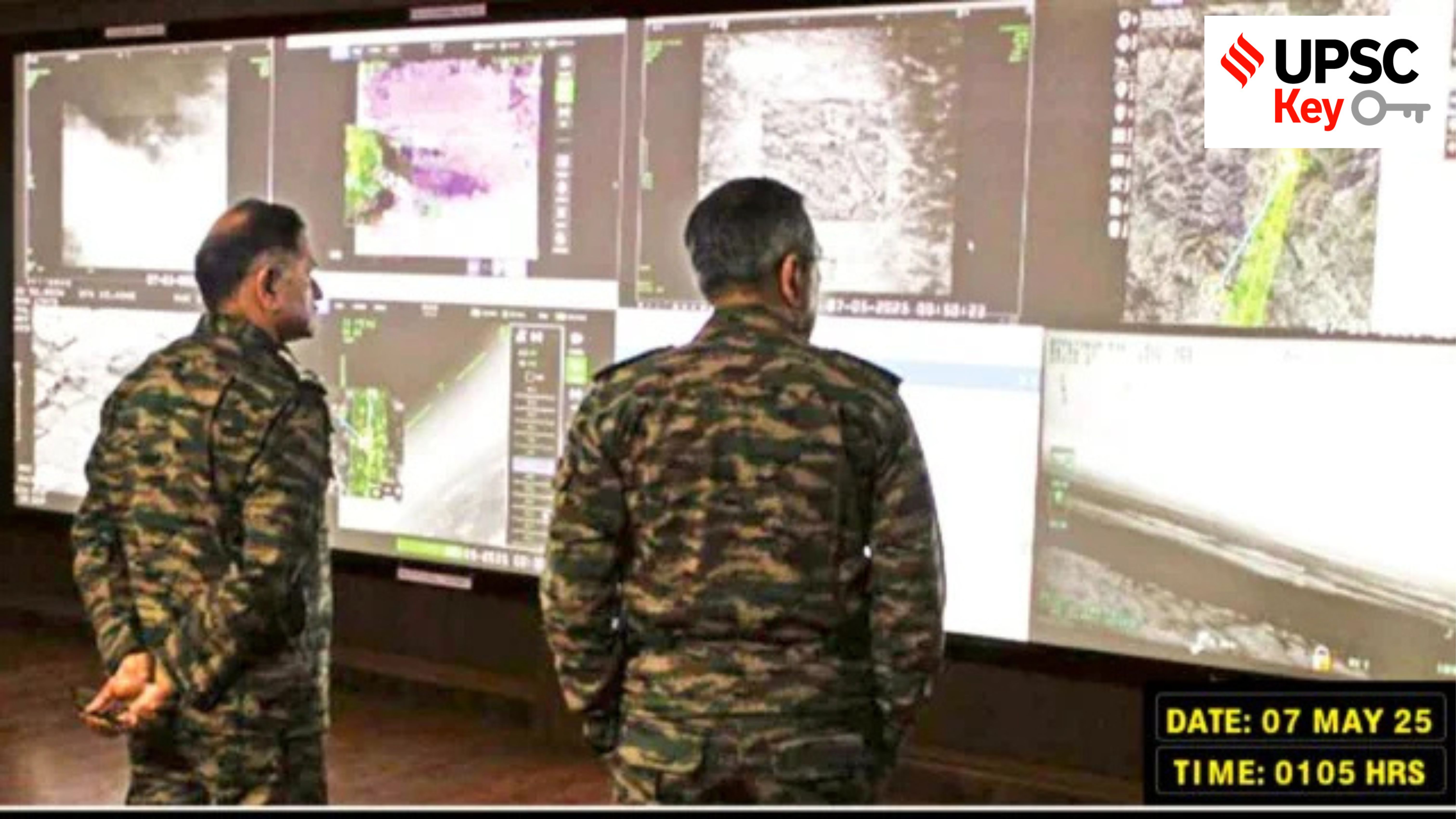
The first topic discussed revolves around 'red teaming' in military strategy, particularly in the context of Operation Sindoor. This involves embedding experts familiar with the adversary’s mindset and tactics into the planning process. Their role is to critically challenge the plan, simulate enemy reactions, and test the robustness of the intended military strategy. The article emphasizes that India's implementation of ‘Red Teaming’ marks a shift in its strategic doctrine, bringing in a more dynamic and anticipatory approach to cross-border operations. The concept was introduced following the Army Commanders’ Conference in October 2024, after which officers underwent specialised training. The aim is to build in-house expertise and eventually reduce dependence on foreign trainers. The Army had also begun exploring the feasibility of creating a dedicated unit to function as an adversarial force to conduct realistic wargaming and enhance combat preparedness. The term ‘red team’ originates from war-game exercises where one group simulates enemy tactics and launches hypothetical attacks against a defending force. In the Indian Army, the concept was named ‘Vidur Vakta’ and was under discussion for some time before being test-bedded across various Army commands.
The second major topic covers the early monsoon onset in Mumbai and its relation to the Madden-Julian Oscillation (MJO). The monsoon arrived two weeks in advance, causing significant waterlogging and disruption. The article explains that the MJO is a complex, moving system of winds, clouds, and pressure that travels eastward and can significantly influence monsoon rainfall over India. This year’s monsoon onset shattered all-time records, arriving in Mumbai on May 24, the earliest since 1950. The India Meteorological Department (IMD) announced the onset of monsoon in Kerala on May 24, the earliest since 2009. The early onset and fast progression were spurred by very favorable conditions, including the active MJO and strong cross-equatorial flow. A low-pressure area in the Arabian Sea also aided the fast movement of the monsoon. Mumbai experienced its wettest May in 107 years, with the Colaba observatory recording 295 mm of rain. The IMD forecasts above-normal monsoon for the country, attributed to neutral El Niño Southern Oscillation (ENSO) and Indian Ocean Dipole (IOD) conditions.
Another significant topic is the railway connectivity project in the North-East, focusing on linking Mizoram’s capital Aizawl to the national railway network via the Bairabi–Sairang line. This is a big push for deeper connectivity in the region. Aizawl becomes the fourth N-E state capital connected to the national railway network. The Bairabi–Sairang New Line is a 51.38-km railway project with a revised sanctioned cost of Rs 5,021.45 crore. The project has achieved 94.52 per cent physical progress and 97.13 per cent financial progress. The remaining sections are slated for operations by June. The project faced engineering challenges due to the difficult terrain, including the construction of 48 tunnels and 55 major bridges. The Bairabi-Sairang project is part of a broader effort to connect all N-E state capitals by rail and enhance infrastructure in the region.
The article also discusses the upcoming Rajya Sabha elections, with the Election Commission announcing June 19 as the polling date for eight seats – two in Assam and six in Tamil Nadu. The Rajya Sabha, or the Council of States, is the Upper House of the Indian Parliament. The House is limited by the Constitution to a maximum of 250 members, out of which 12 members are nominated by the President and 238 are representatives of the States and of the two Union Territories. In Assam, the ruling NDA has the numbers to comfortably win one seat but is likely to fall short by four votes in the second seat. In Tamil Nadu, seat distribution is uncertain. The Upper House is a permanent House and is not subject to dissolution. But one-third of its members retire after every two years. Each member’s term is for six years.
The concerns raised by tribal communities from the Great Nicobar island regarding the Great Nicobar Infrastructure project are also highlighted. The Union Minister for Tribal Affairs stated that these concerns are “under examination”. The mega infrastructure project includes an International Container Transhipment Terminal (ICTT), a greenfield international airport, a township, and a power plant. The project has been opposed on grounds of the threat it poses to the ecology of the islands and the rights of the tribal population, particularly the Shompen. The tribal council had revoked its no-objection certificate to the denotification of a tribal reserve, alleging that it was done without consent of indigenous inhabitants. The project aims to leverage the strategic location of the island, which is roughly equidistant from Colombo and Port Klang/Singapore.
Furthermore, the article touches upon NITI Aayog's proposal for a concessional loan scheme for medium-sized enterprises, arguing that these firms face higher capital costs than both large and small companies. The report titled ‘Designing a Policy for Medium Enterprises’ also called for streamlining research and development (R&D) efforts and expanding cluster-based quality testing. Medium enterprises receive much lesser priority sector loans compared to micro enterprises, and the interest rates are higher than for larger firms. The report proposed a dedicated financing scheme under the Ministry of MSME to allow medium firms to avail loans at concessional rates. The revised thresholds for medium enterprises are Rs 100–500 crore in turnover and Rs 25–125 crore in investment. Despite being a small percentage of registered MSMEs, medium firms account for a significant portion of employment and R&D investment.
The monsoon onset over Kerala was declared on May 24, eight days ahead of schedule. The IMD considers certain essential criteria, including rainfall, wind field, and Outgoing Longwave Radiation (OLR), to declare the monsoon onset. The southwest monsoon has hit India with a bang, covering the southwest and east-central Bay of Bengal, Maldives and Comorin regions, south and central Arabian Sea, Kerala, Lakshadweep and Mahe. It has made a simultaneous and early onset over northeast India (Mizoram), southern and coastal Karnataka and Tamil Nadu. Under normal conditions, the monsoon crosses central Kerala and reaches Karnataka around June 5, making this year’s onset the earliest over these regions in recent years. The Northern Limit of Monsoon now passes through Devgad, Belagavi, Haveri, Mandya, Dharmapuri, Chennai, Aizawl and Kohima.
An innovative use of gene-editing tools is detailed, describing how a nine-month-old boy with a rare genetic disorder, CPS1 deficiency, received a custom gene-editing treatment. The treatment, based on “base editing,” a new version of the CRISPR-Cas9 technology, was developed by scientists and doctors from the University of Pennsylvania and the Children’s Hospital of Philadelphia. CRISPR is an immune system found in microbes that fights invading viruses. The tool works much like the “cut-copy-paste” or “find-replace” functionalities in common computer programs. Base editing and CRISPR-Cas9 differ significantly in how they modify DNA. Base editing enables targeted single-base conversions with the help of a Cas9 enzyme fused to a base-modifying enzyme.
Finally, the article mentions China's upcoming mission to survey and sample a near-Earth asteroid, Tianwen-2. The probe will investigate an asteroid called 469219 Kamo‘oalewa, which orbits the Sun at a distance relatively close to Earth. If successful, the mission will place China in a group of countries that have been able to sample asteroids and return the samples to Earth. Kamo‘oalewa is one of just seven asteroids that fall into a little-understood class known as quasi-satellites of Earth. Scientists believe exploring this asteroid would help them find clues about how quasi-satellites came to be and how their orbits evolved over time. The Tianwen-2 mission will use a “touch-and-go” technique to collect the samples.
Source: UPSC Key: Concept of red teaming, Madden-Julian oscillation and Rajya Sabha elections