
 |
|
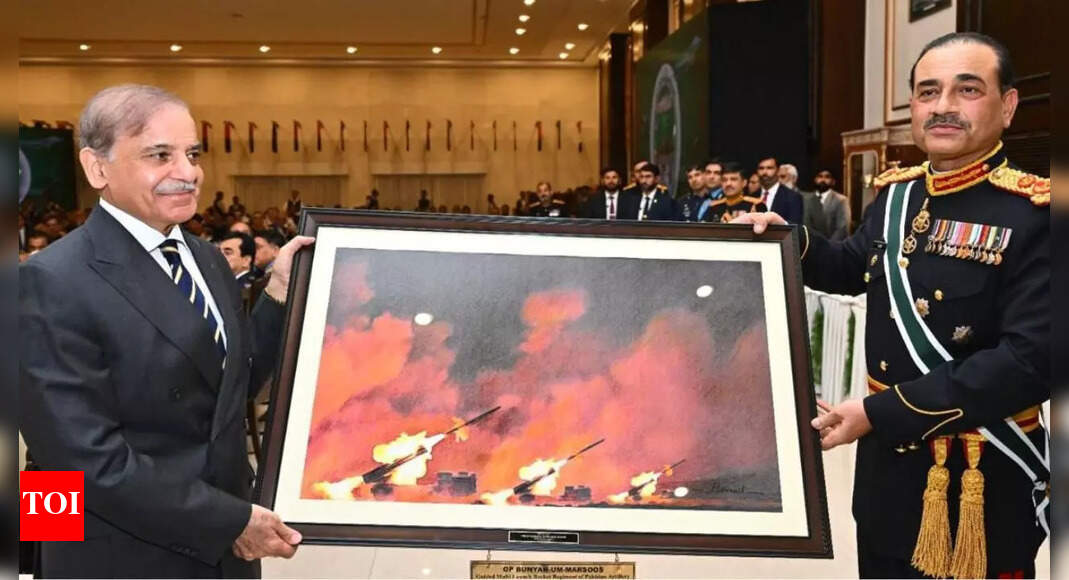
The recent episode involving Pakistan's Prime Minister Shehbaz Sharif gifting a framed photograph to Army chief Gen. Asim Munir, ostensibly to commemorate “Operation Bunyan-ul-Marsoos,” has ignited a storm of controversy and ridicule. The photograph, purported to depict a successful Pakistani military operation, was quickly revealed to be a stock image of a 2019 Chinese rocket artillery drill. This incident has not only sparked widespread condemnation but also raised serious questions about the credibility and strategic communication capabilities of the Pakistani leadership. The act, described as a “bizarre mashup of fantasy and farce,” has been widely interpreted as an attempt to fabricate military prowess and project an image of strength that starkly contrasts with the reality on the ground. The use of a publicly available image from Chinese defence websites underscores a level of desperation and a lack of genuine military achievements to showcase. This incident is particularly embarrassing given the context of escalating tensions between India and Pakistan, especially following India's Operation Sindoor. The timing of this faux pas couldn't be worse for Pakistan, which is already grappling with internal political instability, economic challenges, and increasing international scrutiny over its role in fostering terrorism. The incident has been seized upon by critics, both within and outside Pakistan, as evidence of a deeper malaise affecting the country's governance and strategic thinking. The implications extend beyond mere optics, potentially damaging Pakistan's standing in the international community and eroding trust among its allies. The debacle serves as a stark reminder of the importance of authenticity and transparency in military and political communication. It also highlights the risks associated with resorting to propaganda and misinformation, especially in an era where digital media and fact-checking mechanisms can quickly expose falsehoods. The global dissemination of this embarrassing episode has undoubtedly tarnished Pakistan's image and raised concerns about the judgment and competence of its leaders. The situation is further compounded by the contrast with India's assertive military response to cross-border terrorism, as exemplified by Operation Sindoor. This operation, which involved precision strikes against terrorist infrastructure deep inside Pakistan, demonstrated India's resolve to retaliate against terrorist attacks and its capability to inflict significant damage on terrorist groups operating from Pakistani soil. The contrast between India's decisive action and Pakistan's reliance on fabricated images underscores the differing approaches and strategic priorities of the two nations. It also highlights the challenges Pakistan faces in countering the perception that it is a safe haven for terrorist organizations. The incident involving the fake photograph is not merely a public relations disaster; it is a symptom of a deeper strategic disconnect. Pakistan's leaders seem to be struggling to reconcile the country's ambitions with its limited capabilities and the realities of the regional security environment. The reliance on propaganda and misinformation is a risky strategy that can backfire spectacularly, as this incident has demonstrated. Moving forward, Pakistan needs to adopt a more realistic and transparent approach to its military and political communication. It must focus on building genuine capabilities and addressing the root causes of terrorism within its borders. Only then can it hope to restore its credibility and improve its standing in the international community. The incident also serves as a cautionary tale for other nations that may be tempted to engage in similar tactics. In an age of instant communication and global scrutiny, transparency and authenticity are more important than ever. Attempting to deceive the public or the international community is a dangerous game that can have far-reaching consequences. The episode involving the fake photograph underscores the importance of responsible leadership and strategic communication in maintaining peace and stability in the region. It also highlights the need for greater cooperation and dialogue between India and Pakistan to address the underlying issues that fuel conflict and mistrust. Only through a concerted effort to build trust and promote understanding can the two nations hope to achieve a lasting peace.
Operation Sindoor, India’s recent military response to cross-border terrorism, marks a significant shift in India’s strategic posture. Triggered by the brutal Pahalgam terrorist attack, where tourists were targeted in an execution-style killing, Operation Sindoor represented a decisive move away from symbolic deterrents towards imposing direct, material costs on Pakistan-based terrorist infrastructure. This operation wasn't just about sending a message; it was about degrading the capabilities of terrorist groups and forcing Pakistan's military-terrorist nexus to rethink its operational latitude. The operation was swift, multi-domain, and precise. India employed stand-off weapons, including air-launched cruise missiles, loitering munitions, and long-range drones, to strike nine locations across Pakistan. These targets included Muridke and Bahawalpur, the symbolic and operational hubs of Lashkar-e-Taiba (LeT) and Jaish-e-Mohammed (JeM), two of the most notorious terrorist organizations operating in the region. Unlike previous responses such as the 2016 Uri surgical strikes or the 2019 Balakot airstrike, Operation Sindoor prioritized tangible results over symbolic gestures. The objective was to inflict significant damage on terrorist infrastructure, disrupt their operations, and force them into a defensive posture. The choice of targets and the use of precision-guided munitions reflected a clear intent to minimize collateral damage and maximize the impact on terrorist capabilities. The operation sent a clear message to Pakistan: India is willing and able to strike deep inside Pakistani territory to counter terrorism. This message was reinforced by the fact that the strikes were carried out using stand-off weapons, which allowed India to maintain a safe distance from Pakistani air defenses and minimize the risk of casualties. The success of Operation Sindoor can be attributed to several factors, including meticulous planning, advanced intelligence gathering, and the effective use of technology. The Indian military demonstrated its ability to identify and target key terrorist infrastructure with precision, while minimizing the risk of unintended consequences. The operation also highlighted the growing importance of unmanned aerial vehicles (UAVs) and loitering munitions in modern warfare. These systems allow for persistent surveillance and precision strikes, giving military commanders greater flexibility and control over the battlefield. The strategic implications of Operation Sindoor are far-reaching. By demonstrating its willingness to use force to counter terrorism, India has raised the stakes for Pakistan and forced it to reassess its support for terrorist groups. The operation has also sent a message to the international community that India is committed to combating terrorism and is willing to take decisive action to protect its interests. However, Operation Sindoor is not without its risks. The operation has undoubtedly heightened tensions between India and Pakistan and could lead to further escalation. It is essential that both countries exercise restraint and avoid taking any actions that could further destabilize the region. Moving forward, India needs to continue to strengthen its counterterrorism capabilities and work with its allies to address the root causes of terrorism. This includes addressing the underlying political, economic, and social factors that contribute to radicalization and extremism. It also requires a comprehensive strategy that combines military, intelligence, and diplomatic efforts. The success of Operation Sindoor is a testament to India's growing military power and its commitment to combating terrorism. However, it is important to recognize that military force is only one tool in the fight against terrorism. A comprehensive and multifaceted approach is needed to address the complex challenges posed by terrorism and ensure the long-term security and stability of the region.
The psychological impact of Operation Sindoor on Pakistan-based terror groups is profound and multifaceted. The operation has shattered the sense of impunity that these groups have long enjoyed, forcing them to confront the reality that they are no longer beyond India’s reach. The precise and visible strikes on their most symbolic sanctuaries have triggered a psychological recalibration, forcing them to adopt a survival-first mindset. As War on the Rocks aptly notes, these groups will now have to constantly watch their backs, diverting energy, focus, and resources that were once singularly aimed at India. The constant fear of targeted Indian strikes will undermine their ability to plan large-scale attacks and maintain their operational effectiveness. Terrorist leaders will be forced to operate under heightened security measures, making it more difficult for them to communicate with their followers and coordinate their activities. This will inevitably lead to a decline in their morale and a loss of confidence in their leadership. The operation has also exposed the vulnerability of Pakistan-based terror groups to Indian intelligence and military capabilities. The ability to identify and target key terrorist infrastructure with precision has demonstrated India's superior intelligence gathering and analysis capabilities. This has sent a clear message to these groups that they are being closely monitored and that their activities are not going unnoticed. The psychological impact of Operation Sindoor extends beyond the immediate targets of the strikes. The operation has also sent a message to other terrorist groups in the region that India is willing to use force to protect its interests and that they should not underestimate its resolve. This will likely have a deterrent effect on future terrorist attacks and could lead to a decline in terrorist activity in the region. However, it is important to recognize that the psychological impact of Operation Sindoor is not a one-time event. It will take time for these groups to fully adjust to the new reality and to adapt their strategies accordingly. India needs to continue to maintain pressure on these groups and to ensure that they do not have the opportunity to regroup and re-emerge as a threat. This requires a sustained commitment to counterterrorism efforts and a willingness to use force when necessary. The psychological impact of Operation Sindoor also highlights the importance of information warfare in modern conflict. By effectively communicating its message to the international community and to the Pakistani public, India has been able to shape the narrative surrounding the operation and to undermine the credibility of Pakistan-based terror groups. This has helped to isolate these groups and to reduce their support base. Moving forward, India needs to continue to invest in its information warfare capabilities and to develop effective strategies for countering terrorist propaganda. This includes using social media and other platforms to disseminate accurate information and to expose the lies and distortions of terrorist groups. The psychological impact of Operation Sindoor is a significant achievement in India's fight against terrorism. However, it is important to remember that this is only one battle in a long war. India needs to remain vigilant and to continue to strengthen its counterterrorism capabilities to ensure that it is able to protect its citizens from the threat of terrorism.
Source: Viral photo: Pak PM Shehbaz Sharif gifts Asim Munir a fake image of 'Operation Bunyan' against India