
 |
|
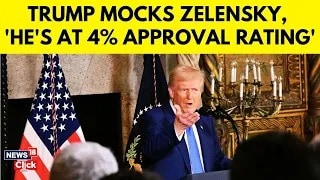
The news that former US President Donald Trump publicly mocked Ukrainian President Volodymyr Zelenskyy's approval rating has sent ripples through the political landscape. Trump's comment, reportedly stating that Zelenskyy's approval rating is 'at 4%', is a significant development given the ongoing war in Ukraine and the substantial international support Zelenskyy has received. The statement's impact extends beyond mere political commentary; it raises questions about the strategic implications of such remarks, the potential for undermining international alliances, and the broader context of public opinion in wartime Ukraine. The low approval rating itself is a complex issue, warranting a detailed examination of its underlying causes and implications for Zelenskyy's leadership and Ukraine's future.
Analyzing the context of Trump's statement reveals several layers of interpretation. First, it is crucial to consider the source. Trump, known for his outspoken and often controversial statements, has a history of making remarks that challenge established norms and international consensus. His comment on Zelenskyy's approval rating could be interpreted as an attempt to discredit Zelenskyy's leadership and undermine international support for Ukraine. This action aligns with Trump's previously expressed views on the war, which have often been characterized as sympathetic towards Russia. Further, the precise source of the 4% figure needs verification. Depending on its origin (reliable polling data versus less credible sources), the figure's accuracy and representativeness of the Ukrainian populace's views becomes pivotal.
The implications of Trump's statement extend beyond the immediate political fallout. International relations are significantly impacted by the words and actions of prominent figures. Trump's comments can be viewed as potentially damaging to the ongoing international effort to support Ukraine in its fight against Russian aggression. Alliances built on mutual respect and shared values can be weakened by such public criticisms. Allies might question the reliability and steadfastness of the United States under a potential future Trump presidency, given his apparent disregard for the challenges faced by Zelenskyy and the Ukrainian people. This raises serious concerns about the predictability and stability of US foreign policy, potentially influencing the decisions of other countries regarding their involvement in the Ukrainian conflict.
Examining Zelenskyy's approval rating itself requires a nuanced understanding of the complexities of wartime leadership. Factors such as the ongoing war, economic hardship, and the emotional toll of prolonged conflict can significantly impact public opinion. It is essential to analyze the methodologies used in any polling data purporting to represent Zelenskyy's approval rating, considering sample size, biases, and the overall limitations of measuring public sentiment during times of war and uncertainty. Simply citing a low approval rating without further context risks oversimplifying a complex reality. Other factors contributing to lower approval ratings might include criticism of government policies, delays in reforms, or difficulties in delivering essential services during wartime.
In conclusion, Trump's mocking comment regarding Zelenskyy's approval rating is far more than a simple political jab; it is a potentially impactful event with far-reaching consequences. The statement raises significant concerns about its impact on international relations, the credibility of US foreign policy, and the complex nature of assessing public opinion during wartime. A thorough investigation into the origin of the approval rating figure is necessary, along with a broader examination of the sociopolitical context in Ukraine to understand the multifaceted challenges facing Zelenskyy's leadership. Further analysis is needed to assess the long-term ramifications of Trump’s remarks and their impact on the dynamics of the ongoing war in Ukraine and the stability of international alliances.
Further research into the methodologies used to obtain the 4% figure is crucial. This would involve examining the polling organizations involved, their sampling methods, question wording, and the margin of error. Additionally, it is important to understand the political climate in Ukraine and any potential biases that might affect public opinion. Analysis of news coverage and public statements surrounding the reported approval rating can provide additional context and help illuminate the broader narrative surrounding Zelenskyy’s leadership.
Source: US President Trump Mocks Zelenskyy, 'He's At 4% Approval Rating'