
 |
|
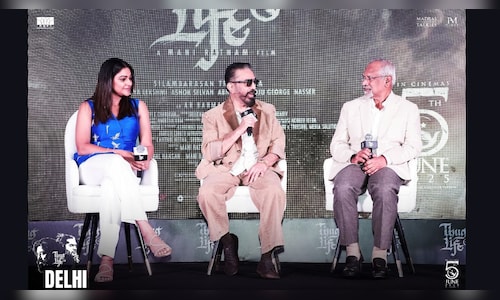
Mani Ratnam's latest offering, Thug Life, arrives with considerable anticipation, fueled by the reunion of the esteemed director with Kamal Haasan after nearly four decades. Their previous collaboration, Nayakan, remains a touchstone of Indian cinema, casting a long shadow over this new venture. However, Thug Life, despite its visual grandeur and star-studded cast, ultimately falters, failing to live up to the expectations set by its illustrious pedigree. The film is described as a 'grand drawl with nothing to say,' a sentiment that encapsulates its central problem: a lack of thematic depth and narrative coherence. The reviewer criticizes the film's inability to engage with any meaningful cultural, social, political, or personal interrogation, positioning it as a watered-down version of Ratnam's signature style. The plot, revolving around Rangaraya Sakthivel (Kamal Haasan), an aging gangster seeking revenge, is deemed a cliché, 'a tale as old as time.' While the initial setup shows promise, with the introduction of various intriguing subplots and characters, the film quickly descends into a chaotic mess, jumping across timelines and locations with little regard for narrative clarity. Important characters are abruptly forgotten, bizarre cameos appear without purpose, and the central conflict lacks emotional resonance. The reviewer highlights the film's reliance on violence as a crutch, suggesting that without it, the story would have little to offer. This critique echoes a broader observation about the state of commercial Indian cinema, where action often substitutes for substance. The film's technical aspects, including Ravi K Chandran's cinematography and A Sreekar Prasad's editing, are praised, as is AR Rahman's music. However, these elements are ultimately insufficient to salvage the film's flawed narrative. The reviewer also points out the 'pan-India problem,' where Bollywood actors are brought in for fleeting appearances, adding little to the overall story. The film's second half is particularly criticized, with the reviewer noting that everything built up until that point 'spectacularly crashes like a house of cards.' The reviewer points to specific instances, such as a cringe-worthy dialogue ('Madam, I’m your only Adam') and Haasan's character's improbable survival, as examples of the film's overreliance on 'willing suspension of disbelief.' Ultimately, Thug Life is portrayed as a disappointing effort from a director of Mani Ratnam's caliber, a visually impressive but narratively hollow spectacle that fails to engage with its audience on a deeper level. The promise of a reunion between Ratnam and Haasan remains unfulfilled, leaving viewers with a sense of missed opportunity.
The film's narrative structure is a significant point of contention in the review. The constant jumping between timelines and locations, coupled with the introduction and subsequent abandonment of various subplots, creates a sense of confusion and disorientation. The reviewer questions the purpose of these narrative detours, suggesting that they serve only to distract from the film's central storyline. The film's emotional undercurrents, which the reviewer acknowledges as being 'rich and resonant,' are ultimately overshadowed by the film's relentless pace and focus on action. The reviewer laments the fact that the film never allows these emotional threads to fully develop, resulting in a superficial and emotionally unfulfilling experience. The character of Rangaraya Sakthivel, played by Kamal Haasan, is also subject to scrutiny. While Haasan's performance is acknowledged as being exemplary, the reviewer questions the believability of his character's actions, particularly in the later parts of the film. The reviewer points out that Haasan is 'too old to play a convincing action hero anymore,' and that his character's improbable survival stretches the limits of credibility. The film's use of violence is also criticized, with the reviewer suggesting that it is employed as a substitute for meaningful character development and narrative depth. The reviewer notes that the film relies heavily on action sequences to maintain audience engagement, but that these sequences ultimately feel empty and devoid of emotional weight. The reviewer highlights the film's failure to explore the psychological and emotional consequences of violence, portraying it instead as a purely aesthetic spectacle. The reviewer also criticizes the film's treatment of its female characters, suggesting that they are relegated to secondary roles and given little agency in the story. The reviewer notes that the film fails to provide these characters with meaningful motivations or backstories, reducing them to mere plot devices. The reviewer argues that this portrayal of women is indicative of a broader problem in Indian cinema, where female characters are often marginalized and objectified.
Furthermore, the film's attempt to cater to a pan-Indian audience is seen as a misstep. The inclusion of actors from Bollywood, while intended to broaden the film's appeal, ultimately feels forced and artificial. The reviewer notes that these actors are given little to do, and that their presence serves only to dilute the film's cultural identity. The film's dialogue is also subject to criticism, with the reviewer citing a particularly cringeworthy line ('Madam, I’m your only Adam') as an example of its lack of sophistication. The reviewer suggests that the film's dialogue is often clichéd and uninspired, failing to capture the nuances of human interaction. The film's overall tone is also questioned, with the reviewer suggesting that it is inconsistent and uneven. The reviewer notes that the film oscillates between moments of serious drama and lighthearted comedy, without ever fully committing to either. This tonal ambiguity creates a sense of confusion and disorientation, making it difficult for the audience to connect with the film on an emotional level. In conclusion, Thug Life is a film that promises much but delivers little. Despite its impressive visuals, talented cast, and esteemed director, the film ultimately fails to cohere into a satisfying or meaningful cinematic experience. The film's flawed narrative structure, reliance on violence, and superficial character development all contribute to its ultimate failure. The reviewer suggests that Thug Life is a disappointing effort from Mani Ratnam, a director who has consistently pushed the boundaries of Indian cinema. The film serves as a reminder that visual spectacle and star power are not enough to compensate for a lack of thematic depth and narrative coherence. The film is a wasted opportunity, a missed chance to explore complex themes and create memorable characters. Ultimately, Thug Life is a film that is easily forgotten, a fleeting moment of cinematic indulgence that leaves little lasting impact.
The initial anticipation surrounding Thug Life stemmed not only from the reunion of Mani Ratnam and Kamal Haasan but also from the director's consistent ability to weave intricate narratives with compelling characters. Ratnam's previous works often delved into the complexities of human relationships against the backdrop of social and political turmoil, creating films that were both entertaining and thought-provoking. Thug Life, however, deviates from this established pattern, opting for a more straightforward action-oriented approach that lacks the thematic depth and nuance of Ratnam's earlier films. The reviewer's critique extends beyond the film's narrative shortcomings to encompass its overall artistic vision. The film's visual grandeur, while undeniably impressive, is ultimately seen as a superficial distraction from its lack of substance. The reviewer suggests that Ratnam has prioritized spectacle over storytelling, resulting in a film that is visually appealing but emotionally empty. The film's use of music, while commendable in its own right, is also criticized for its failure to enhance the narrative. The reviewer suggests that the film's soundtrack, while catchy and well-produced, often feels disconnected from the on-screen action, failing to create a sense of emotional resonance. The film's overall pacing is also a point of contention. The reviewer notes that the film's relentless pace, while initially engaging, ultimately becomes exhausting, preventing the audience from fully absorbing the film's themes and characters. The reviewer suggests that Ratnam has sacrificed subtlety and nuance in favor of speed and spectacle, resulting in a film that is both overwhelming and ultimately unsatisfying. The film's ending is also subject to criticism, with the reviewer suggesting that it is anticlimactic and unfulfilling. The reviewer notes that the film fails to provide a sense of closure or resolution, leaving the audience with a feeling of incompleteness. The reviewer suggests that Ratnam has failed to adequately address the film's central themes, resulting in an ending that feels abrupt and unsatisfying.
In essence, the review paints a picture of a film that is technically proficient but artistically bankrupt. Thug Life is a visually stunning and technically impressive spectacle, but it lacks the heart and soul of Ratnam's best work. The film's flaws are not merely cosmetic; they are deeply ingrained in its narrative structure, character development, and thematic exploration. The reviewer's disappointment is palpable, reflecting a sense of missed opportunity and unfulfilled potential. Thug Life is a film that could have been great, but it ultimately falls short of expectations. The film's failure is particularly disheartening given the talent and experience of its creators. Mani Ratnam is a director who has consistently challenged and redefined the boundaries of Indian cinema, and Kamal Haasan is an actor who has delivered countless memorable performances. The combination of these two talents should have produced something truly special, but Thug Life is ultimately a disappointment. The film serves as a cautionary tale, reminding us that even the most talented artists can sometimes falter. It also highlights the importance of substance over style, and the need for filmmakers to prioritize storytelling over spectacle. Thug Life is a film that will likely be remembered for its visual grandeur and star power, but it will also be remembered for its lack of thematic depth and narrative coherence. The film is a missed opportunity, a wasted potential, and a disappointing effort from two of Indian cinema's most respected figures. The legacy of Mani Ratnam and Kamal Haasan remains intact, but Thug Life will undoubtedly be viewed as a minor footnote in their illustrious careers. The film's failure is not necessarily a reflection of their talent, but rather a testament to the challenges of filmmaking and the unpredictable nature of artistic success.
Source: Thug Life movie review: A grand drawl with nothing to say