
 |
|
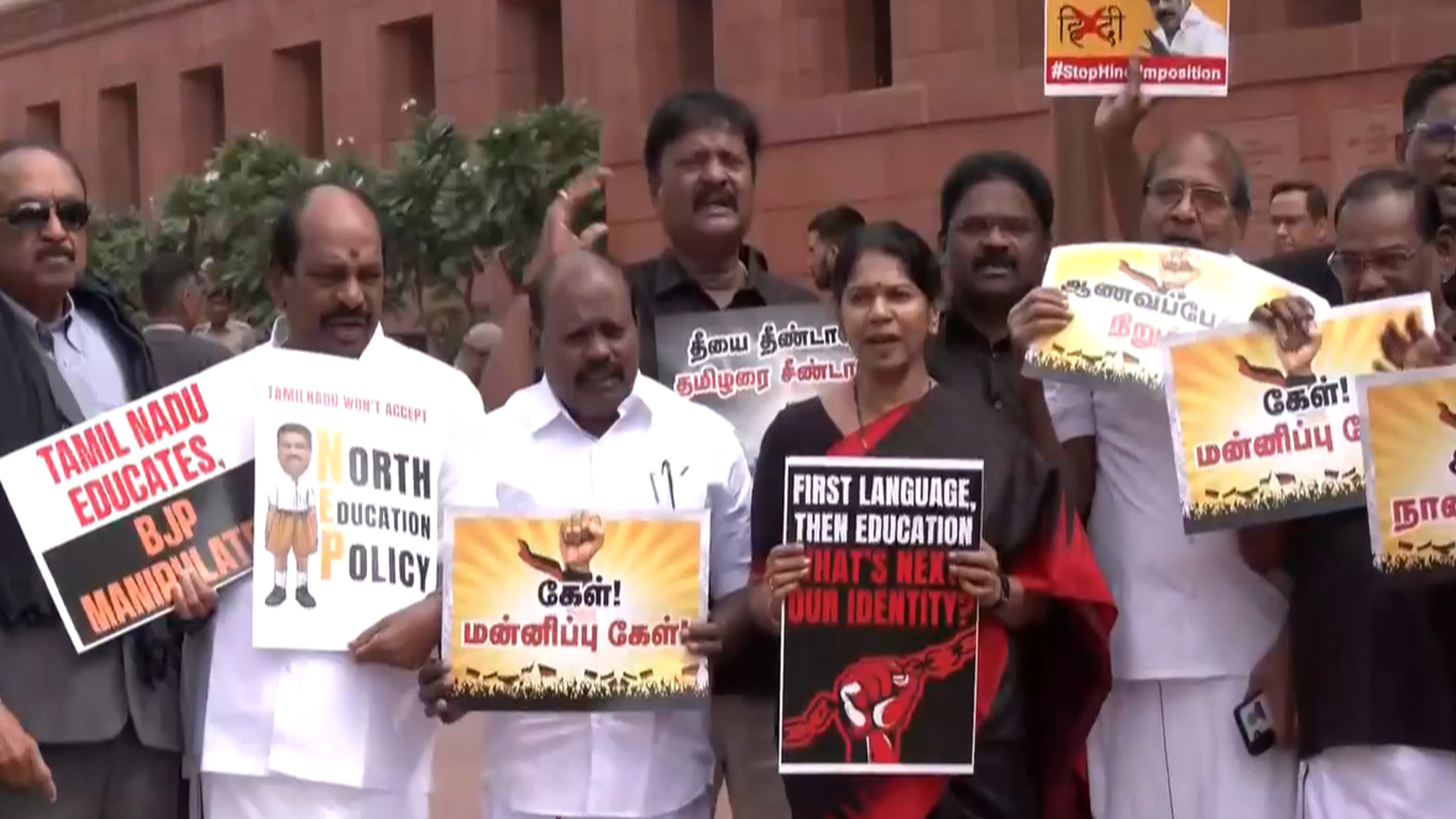
The core of this political event centers on the Dravida Munnetra Kazhagam's (DMK) vehement opposition to the National Education Policy (NEP), specifically concerning the three-language formula, and their discontent with Union Education Minister Dharmendra Pradhan's statements regarding the policy in Parliament. The protest, led by DMK Member of Parliament Kanimozhi Karunanidhi, signifies a deeper struggle over linguistic and cultural identity, federalism, and the perceived imposition of Hindi on non-Hindi speaking states. The three-language formula, as envisioned in the NEP, proposes that students learn three languages: their mother tongue or regional language, Hindi (for non-Hindi speaking states), and English. This policy has historically faced resistance, particularly in Tamil Nadu, where it is viewed as a covert attempt to promote Hindi at the expense of Tamil and other regional languages. The DMK's opposition is rooted in the legacy of the anti-Hindi agitations that have shaped Tamil Nadu's political landscape for decades. These agitations, which gained momentum in the mid-20th century, were driven by fears of linguistic and cultural domination by the Hindi-speaking north, and they played a crucial role in solidifying the DMK's political power base. The current protest is not simply a reaction to a specific policy; it is a continuation of this long-standing resistance against perceived linguistic imperialism. The concerns extend beyond the practical challenges of implementing a three-language system in diverse classrooms. They touch upon fundamental questions of cultural identity, self-determination, and the preservation of regional languages. The DMK argues that the imposition of Hindi undermines the unique cultural heritage of Tamil Nadu and infringes upon the state's autonomy in educational matters. The protest also highlights the complex relationship between the central government and state governments in India, particularly in areas such as education, where both have overlapping responsibilities. The NEP, as a national policy framework, seeks to provide a uniform educational structure across the country. However, its implementation requires the cooperation and consent of state governments, which have their own distinct educational priorities and concerns. The DMK's protest underscores the challenges of achieving consensus on national policies that have significant implications for regional cultures and languages. Furthermore, the protest gains political significance considering the larger backdrop of Centre-State relations in India. Opposition parties across the country have increasingly accused the central government of encroaching upon the powers of state governments, particularly in matters of finance and governance. The NEP and the three-language formula have become symbols of this perceived centralization of power, fueling resentment among regional parties like the DMK. The protest also aims to exert political pressure on the central government to reconsider its approach to the three-language formula and to engage in a more meaningful dialogue with state governments and stakeholders. The DMK is likely to use the issue to mobilize public opinion in Tamil Nadu and to strengthen its position as the champion of Tamil language and culture. The party may also seek to forge alliances with other regional parties that share similar concerns about the NEP and the three-language formula. The impact of the protest on the future of the NEP and the three-language formula remains to be seen. However, it is clear that the DMK's opposition will continue to be a significant factor in shaping the debate around education policy in India. The central government will need to address the concerns raised by the DMK and other stakeholders if it hopes to achieve widespread acceptance of the NEP. The DMK's protest also serves as a reminder of the importance of linguistic diversity and cultural sensitivity in a multi-ethnic and multi-lingual country like India. Any attempt to impose a uniform educational system without taking into account the unique needs and aspirations of different regions is likely to face resistance. Ultimately, a successful education policy must be inclusive, equitable, and respectful of the linguistic and cultural heritage of all communities.
The DMK's specific grievances against Education Minister Dharmendra Pradhan likely stem from his perceived defense of the three-language formula in Parliament. His remarks could have been interpreted as dismissive of the concerns raised by the DMK and other parties, further fueling their anger and frustration. It is possible that Pradhan's statements lacked the necessary sensitivity and nuance, failing to adequately address the deep-seated anxieties surrounding the issue of Hindi imposition. The DMK has historically viewed any attempt to promote Hindi as a threat to Tamil language and culture, and they are likely to be particularly sensitive to any perceived insensitivity on the part of central government officials. Furthermore, the timing of the protest is also significant. It comes at a time when the NEP is being rolled out across the country, and state governments are grappling with the challenges of implementing its various provisions. The DMK's protest can be seen as an attempt to influence the implementation process and to ensure that the concerns of Tamil Nadu are taken into account. The party may also be seeking to leverage the issue to gain political advantage in the upcoming elections. The DMK's protest also highlights the importance of effective communication and consultation in the formulation and implementation of national policies. The central government needs to engage in a more meaningful dialogue with state governments and other stakeholders to address their concerns and to build consensus on key policy issues. This requires a willingness to listen to different perspectives and to make necessary adjustments to accommodate the unique needs and aspirations of different regions. Failure to do so can lead to increased political tension and undermine the legitimacy of national policies. The DMK's protest also underscores the ongoing debate about the role of language in nation-building. In a country as diverse as India, language can be a powerful tool for promoting unity and integration. However, it can also be a source of division and conflict if not handled carefully. The central government needs to adopt a more inclusive and sensitive approach to language policy, one that respects the linguistic diversity of the country and promotes the equal development of all languages. This requires investing in the promotion of regional languages and ensuring that students have access to quality education in their mother tongue. The central government must be seen as a facilitator, not an imposer, of language policies. This means empowering states to make their own decisions about language education, while providing support and resources to help them achieve their goals. The DMK's protest is a wake-up call for the central government to address the concerns of regional parties and to adopt a more inclusive and collaborative approach to policy-making. Only through dialogue and compromise can India overcome its linguistic and cultural divisions and build a stronger and more united nation. The protests are a reflection of deeply ingrained historical and cultural anxieties that cannot be easily dismissed or ignored. The central government's response to this protest will be crucial in shaping the future of Centre-State relations and the overall success of the NEP. This hinges on demonstrating genuine respect for regional linguistic identity and fostering a spirit of collaborative governance.
The legacy of the anti-Hindi agitations casts a long shadow on Tamil Nadu's political landscape, shaping the DMK's ideology and its relationship with the central government. These agitations, which began in the 1930s and intensified in the post-independence era, were fueled by fears that the imposition of Hindi would marginalize Tamil and other regional languages, undermining their cultural significance and limiting opportunities for non-Hindi speakers in education and employment. The DMK emerged as a leading force in these agitations, mobilizing large-scale protests and advocating for the protection of Tamil language and culture. The party's success in these struggles helped to solidify its political power base and establish its image as the champion of Tamil identity. The anti-Hindi agitations also had a profound impact on the political culture of Tamil Nadu, fostering a strong sense of regional pride and a deep-seated suspicion of central government policies that are perceived as threatening to Tamil autonomy. This historical context is crucial for understanding the DMK's current opposition to the NEP and the three-language formula. The party's leaders see the policy as a continuation of the long-standing effort to promote Hindi at the expense of Tamil and other regional languages. They argue that the imposition of Hindi undermines the unique cultural heritage of Tamil Nadu and infringes upon the state's autonomy in educational matters. The DMK's position is also influenced by the political dynamics of Tamil Nadu, where language and culture are powerful symbols of identity and political mobilization. The party is likely to use the issue to rally its supporters and to strengthen its position as the defender of Tamil interests. The anti-Hindi sentiment in Tamil Nadu is not simply a matter of linguistic preference; it is deeply intertwined with questions of social justice, economic opportunity, and political power. The DMK argues that the imposition of Hindi would disadvantage Tamil speakers in the job market and limit their access to higher education and government services. They also see it as a threat to the cultural identity of Tamil Nadu, which has a rich history and a vibrant literary tradition. The DMK's opposition to the NEP and the three-language formula is therefore a complex and multifaceted issue, rooted in the historical legacy of the anti-Hindi agitations and shaped by the political and cultural dynamics of Tamil Nadu. The party's leaders are committed to defending Tamil language and culture, and they will continue to resist any attempt to impose Hindi on the state. The protests are a testament to the enduring power of language and culture in shaping political identities and mobilizing collective action. The central government must recognize the historical and cultural context of Tamil Nadu and engage in a more meaningful dialogue with the DMK and other stakeholders to address their concerns and to build consensus on education policy. This requires a willingness to compromise and to respect the linguistic diversity of India. The DMK's stance is not merely political posturing; it reflects deeply held beliefs about cultural preservation and regional autonomy, shaped by decades of struggle and sacrifice. Understanding this historical context is essential for navigating the complexities of Indian politics and fostering a more inclusive and equitable society. The central government’s approach must be sensitive to this history, ensuring that any national policy respects the linguistic and cultural heritage of all regions.
Ultimately, resolving the conflict surrounding the three-language formula requires a nuanced approach that recognizes the importance of both national unity and regional diversity. A key element of this approach is fostering a spirit of mutual respect and understanding between different linguistic communities. This can be achieved through promoting multilingualism and encouraging students to learn about the cultures and histories of different regions of India. The central government can play a crucial role in supporting the development of regional languages and providing resources for teaching them in schools. This would not only help to preserve the linguistic diversity of the country but also enhance the educational opportunities of students who speak these languages. Another important aspect of resolving the conflict is ensuring that the three-language formula is implemented in a flexible and sensitive manner. State governments should have the autonomy to adapt the policy to their specific needs and circumstances, taking into account the linguistic preferences of their students and the availability of resources. The central government should also avoid imposing any rigid or mandatory requirements that could be seen as infringing upon the autonomy of state governments. In addition to these measures, it is also important to address the underlying concerns about social justice and economic opportunity that fuel the opposition to Hindi imposition. This requires creating a level playing field for all linguistic communities and ensuring that Hindi speakers do not have an unfair advantage in the job market or in access to higher education. The central government can also promote the use of regional languages in government services and in the media, creating more opportunities for people who speak these languages. Resolving the conflict surrounding the three-language formula is a long-term process that requires sustained effort and commitment from all stakeholders. It is not a problem that can be solved overnight or through quick fixes. It requires a willingness to listen to different perspectives, to compromise, and to build consensus. The DMK's protest serves as a reminder of the importance of addressing the underlying causes of the conflict and of adopting a more inclusive and sensitive approach to language policy. The central government must seize this opportunity to engage in a more meaningful dialogue with state governments and other stakeholders and to work together to find a solution that respects the linguistic diversity of India and promotes national unity. Only through collaboration and compromise can India overcome its linguistic divisions and build a stronger and more equitable society. The path forward requires careful consideration of historical grievances, cultural sensitivities, and the practical challenges of implementing a multilingual education system. A successful resolution will not only benefit the education sector but also contribute to a more cohesive and harmonious nation.
The incident also highlights the ongoing debate about the balance of power between the central government and state governments in India's federal system. Education, while appearing in the Concurrent List of the Constitution (allowing both Centre and States to legislate on it), has traditionally seen significant state autonomy. The NEP, framed as a national policy, inevitably steps into areas of state jurisdiction, raising concerns about centralization. The DMK, a strong proponent of state rights, perceives the three-language formula as an encroachment upon the state's prerogative to determine its educational policies. This perceived infringement fuels the opposition and contributes to the larger narrative of the central government undermining federal principles. The protest, therefore, is not solely about language; it's a manifestation of broader anxieties about the erosion of state autonomy and the increasing concentration of power in the hands of the central government. The DMK's actions can be interpreted as a defense of the federal structure and a demand for greater state control over matters that directly impact regional identity and culture. The central government, on the other hand, may argue that a uniform national education policy is necessary to ensure quality and consistency across the country, regardless of regional variations. This divergence in perspectives underscores the inherent tension in a federal system, where the pursuit of national goals must be balanced with the protection of regional interests. The resolution of this tension requires open dialogue, mutual respect, and a willingness to compromise on both sides. The central government must demonstrate sensitivity to the concerns of state governments and avoid imposing policies that are perceived as infringing upon their autonomy. State governments, in turn, must recognize the need for national standards and collaborate with the central government to achieve common educational goals. A collaborative approach, based on shared responsibility and mutual respect, is essential for maintaining the integrity of the federal system and ensuring that national policies are implemented in a way that is both effective and equitable. This requires a commitment to open communication, transparency, and a willingness to adapt policies to the specific needs and circumstances of different regions. The challenge lies in finding a balance between national unity and regional diversity, ensuring that the pursuit of common goals does not come at the expense of local autonomy and cultural identity. The success of the NEP, and the resolution of conflicts like the one involving the three-language formula, will depend on the ability of the central government and state governments to work together in a spirit of cooperation and mutual understanding.
Source: DMK Vs Dharmendra Pradhan: DMK, Congress Protest Over 3-Language Policy