
 |
|
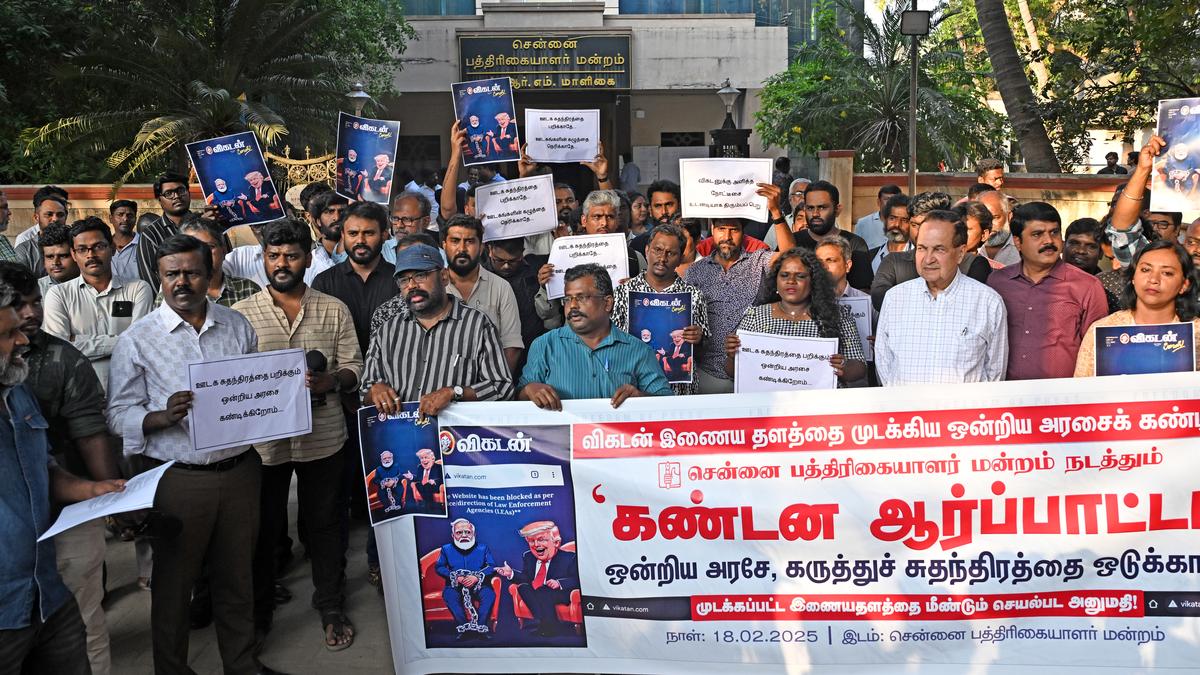
The recent blocking of the Vikatan Plus digital magazine by the Indian Union government has sparked outrage and protests among journalists, highlighting concerns about freedom of the press and censorship in the country. The incident centers around a satirical cartoon published on the website depicting Prime Minister Narendra Modi and former US President Donald Trump, which the government deemed offensive enough to warrant the site's immediate blocking under Section 69-A of the Information Technology Act. This action, taken without prior notice to the publication, has drawn sharp criticism from journalists and media organizations alike.
The protest, organized by the Chennai Press Club, brought together journalists from various media houses who voiced their strong condemnation of the government's unilateral action. Veteran journalist N. Ram, Director of THG Publishing Private Limited, criticized the lack of due process and prior notice, emphasizing the violation of natural justice and established legal procedures. He pointed to a previous legal precedent, citing the case of S. Balasubramanian, the former editor of Ananda Vikatan, who was imprisoned by the Tamil Nadu Assembly for publishing a satirical cartoon but later vindicated by the Madras High Court. This precedent underscores the potential legal challenges the government might face if the matter proceeds to court.
The protest also highlighted a broader concern regarding the use of cartoons as a weapon to suppress political satire and criticism. M. Gunasekaran, Editor-in-Chief of Sun News, argued that the use of cartoons in political commentary is a long-standing tradition in the media and that the government's action represents a blatant attempt to stifle freedom of expression. Suresh Vedhanayagam, president of the Chennai Press Club, and Haseef Mohammed, general secretary, further emphasized the procedural irregularities involved in blocking the website without adhering to the due process outlined in Section 69-A of the Information Technology Act. They stressed the importance of upholding the principles of freedom of speech and the right to access information, even when such information might be considered critical of those in power.
The swift condemnation of the website blocking by Chief Minister M.K. Stalin added further weight to the protest. His statement underscores the bipartisan nature of concern over this action, transcending political affiliations. The incident brings into sharp focus the delicate balance between maintaining national security and upholding fundamental rights, particularly the freedom of expression. The government's action raises serious questions about its commitment to these principles and the potential implications for media freedom in India.
The controversy surrounding Vikatan Plus underscores a larger debate regarding the limits of freedom of expression in a democratic society. While concerns about national security and public order are legitimate, the government's approach in this case appears heavy-handed and disproportionate. The lack of transparency and due process raises serious questions about accountability and the potential for misuse of power. The incident serves as a stark reminder of the importance of safeguarding the freedom of the press and ensuring that legitimate criticism is not suppressed under the guise of national interest. The outcome of the hearing scheduled for Thursday, and any subsequent legal challenges, will have significant implications for freedom of the press in India and the ability of journalists to hold those in power accountable.
The incident is not an isolated case; it reflects a broader pattern of increasing pressure on the media in India. Journalists and media outlets often face harassment, intimidation, and legal challenges for their critical reporting. This incident serves as a stark warning to other media organizations and highlights the need for continued vigilance in defending the principles of freedom of expression. The international community should also take note of this incident, as it sets a precedent that could have implications for press freedom globally. The call for greater transparency and accountability in government actions is paramount, particularly when it comes to matters affecting fundamental rights.
The future of this case will determine not just the fate of Vikatan Plus but also the wider implications for freedom of the press in India. The upcoming hearing and any subsequent legal actions will be closely watched by media organizations and civil liberties advocates both domestically and internationally. This incident highlights the ongoing struggle between those who seek to uphold freedom of expression and those who use power to suppress it. The event serves as a reminder that the fight for press freedom is a continuous battle that requires constant vigilance and a unwavering commitment to democratic principles.
Source: Journalists stage protest condemning the blocking of Vikatan Plus digital magazine