
 |
|
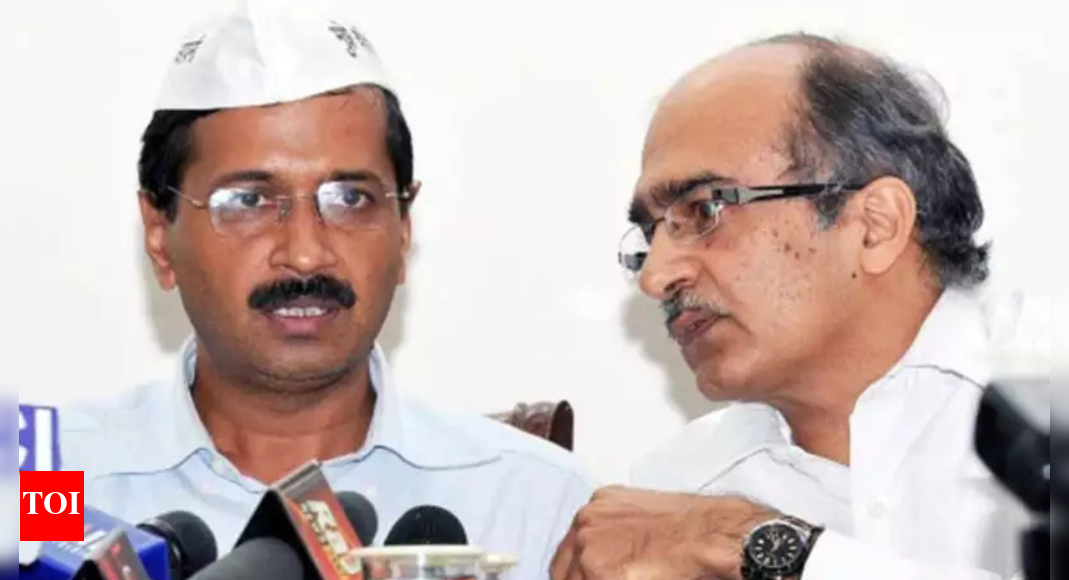
Prashant Bhushan, a former co-founder of the Aam Aadmi Party (AAP), has squarely placed the blame for the party's significant loss in the recent Delhi assembly elections on Arvind Kejriwal, the party's leader. Bhushan's accusations, delivered via social media and a previously written open letter, paint a picture of a party drastically diverging from its initial ideals of transparency and accountability. He alleges that Kejriwal's leadership has transformed AAP into a 'supremo-dominated,' corrupt organization, a stark contrast to the party's original vision of alternative politics.
Central to Bhushan's critique is the claim that Kejriwal prioritized personal opulence over the party's core principles. The construction of a lavish 'sheesh mahal' (palace of mirrors) and the adoption of a luxurious lifestyle are presented as symbols of Kejriwal's detachment from the party's grassroots and its commitment to fighting corruption. This narrative is further strengthened by Bhushan's assertion that Kejriwal disregarded detailed policy reports prepared by expert committees, opting instead for what Bhushan describes as 'expedient policies' driven by bluster and propaganda. This alleged disregard for well-researched policy proposals underscores the claim of a leadership prioritizing short-term political gains over long-term strategic planning and adherence to principle.
Bhushan's accusations extend beyond accusations of corruption and self-indulgence. He points to the suppression of internal dissent and the removal of the party's own Lokpal (ombudsman) as evidence of a deliberate move towards a non-transparent and autocratic structure. The expulsion of Bhushan and Yogendra Yadav, fellow AAP founding members, is cited as a key example of this suppression. Bhushan's 2015 open letter to Kejriwal, which is referenced in the article, foreshadowed the current concerns. In the letter, Bhushan warned Kejriwal that his leadership style threatened to transform the party's initial dream of clean and principled politics into a 'nightmare.' This prescient warning now resonates strongly given AAP's recent electoral performance.
The drastic reduction in AAP's seat count from 62 to 22 in the Delhi elections serves as a powerful illustration of Bhushan's arguments. The BJP's resounding victory, marking a return to power after 27 years, underscores the magnitude of AAP's defeat and the potential validity of Bhushan's criticisms. While the reasons behind AAP's electoral setback are likely multifaceted, Bhushan's accusations raise significant questions about the internal dynamics of the party and the impact of Kejriwal's leadership style on its overall trajectory. The future of AAP, in light of these accusations and the substantial electoral loss, remains uncertain, prompting speculation about the party's ability to regain its former standing and its ability to return to its original ethos.
The implications of Bhushan's accusations extend beyond the internal affairs of AAP. They raise broader questions about the challenges of maintaining ideological purity and accountability within political parties, particularly those that rise to prominence on a platform of anti-corruption and transparency. The contrast between AAP's initial promise and its current state, as portrayed by Bhushan, serves as a cautionary tale about the potential pitfalls of unchecked power and the importance of maintaining internal democratic processes within political organizations. The narrative also highlights the ongoing debate surrounding the efficacy and sustainability of alternative political movements within established political systems.